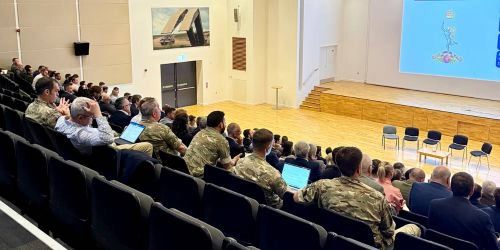
The Royal Signals Institution recently welcomed Dr Colin Williams, Principal Consultant at CDS Defence & Security, Visiting Fellow in Cyber Security, and Royal Signals Reservist, for a fascinating lecture exploring the hidden histories of artificial intelligence.
Far from being a product of the last decade, AI’s roots lie in wartime innovation, Cold War rivalries, and a fundamental intellectual battle between two competing visions of machine intelligence: cybernetics and algorithmic AI.
From “Robots” to Robot Wars
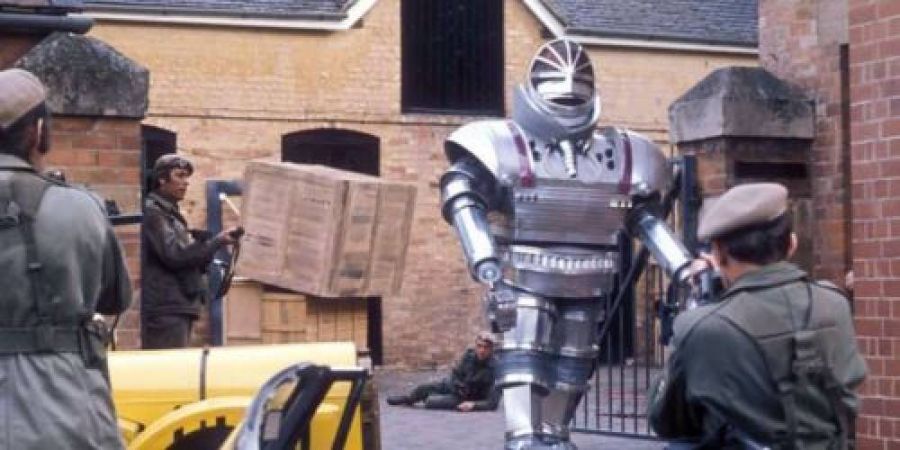
Williams began by tracing the origins of the word robot to Karel Čapek’s 1920 play R.U.R. (Rossum’s Universal Robots). Initially conceived as organic labourers indistinguishable from humans, the robot quickly entered British and American culture - by the Second World War it described not fiction, but reality.
Britain’s confrontation with the V-1 “robot bomb” and the subsequent deployment of automated, radar-directed anti-aircraft systems highlighted a new age: machines acting with minimal human oversight, performing cognitive and adaptive tasks previously reserved for people.
The Rise of Cybernetics
From these wartime experiences grew the discipline of cybernetics. Norbert Wiener’s seminal 1948 book Cybernetics: Control and Communication in the Animal and the Machine argued that humans and machines were fundamentally comparable information-processing agents. Feedback, self-adaptation, and probabilistic reasoning became the language of both physiology and computation.
Cybernetics inspired early neural networks, self-learning devices, and robotics - technologies that blurred the boundary between human and machine agency. Importantly, Alan Turing and his contemporaries in Britain were deeply engaged in this tradition, seeing computation as more than arithmetic: it was a route to synthetic cognition.
The Schism: AI versus Cybernetics
Yet in 1956, a split occurred. John McCarthy and others, meeting at the famous Dartmouth conference, advanced a different model - what became known as artificial intelligence. Their vision was symbolic, rule-based, and algorithmic: machines would follow logic, rather than learn and adapt like organisms.
As Williams explained, this divergence shaped decades of research. Cybernetics, with its emphasis on embodied, adaptive systems, lost ground in the West - while symbolic AI dominated academia, leading to cycles of hype and “AI winters.” Ironically, many of today’s breakthroughs in machine learning and generative AI represent a partial return to the cybernetic tradition.
Contemporary Relevance
The lecture closed by drawing lessons for today.
- Human exceptionalism challenged – If every dimension of cognition can in principle be replicated physically, on what basis do we distinguish human from machine agency?
- Ethics and rights – As augmentation blurs the line between “meat” and “metal,” questions arise about human rights, machine rights, and the responsibilities of deploying synthetic agents.
- Strategic implications – Just as cybernetics once offered a different path for AI, revisiting this history may open new approaches to resilience, C2 design, and human–machine teaming in Defence.
Williams reminded the audience that the debates begun in the 1940s are far from settled. The struggle to reconcile cybernetics and AI continues to shape not only technology, but law, ethics, and security in the 21st century.
The full slide deck from Dr Williams’ lecture is available [here].