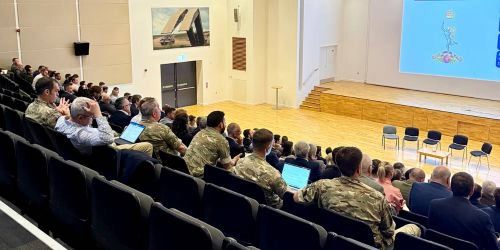
The Royal Signals Institution welcomed Maj Andy Sutton MBE for a thought-provoking lecture exploring how optical communications could fundamentally reshape the way military headquarters are deployed and operated in the future.
Drawing on both his extensive telecommunications expertise and recent work supporting defence planning, Sutton examined whether modern headquarters could significantly reduce their reliance on radio-frequency communications by exploiting the growing availability of fibre-optic infrastructure.
At the heart of the presentation was a simple but powerful question: "Can we deploy a headquarters without radio?" Sutton acknowledged that the complete elimination of radio communications is unlikely. However, he argued that modern optical networking technologies offer considerable opportunities to reduce electromagnetic emissions while simultaneously delivering communications that are faster, more reliable and significantly harder to detect than traditional radio-based systems.
The challenge of the modern battlespace
The lecture began by placing the discussion within the wider context of contemporary warfare. Drawing lessons from the conflict in Ukraine, Sutton highlighted how modern sensor systems, drones, satellites and electronic warfare capabilities have transformed the battlespace. Headquarters that emit significant radio-frequency signatures are increasingly vulnerable to detection, targeting and attack. As a result, future headquarters are likely to become more dispersed, more mobile and more dependent upon resilient communications networks that can function while maintaining strict emissions control.
Against this backdrop, fibre-optic communications offer a compelling alternative. Unlike radio systems, optical fibre generates no radio-frequency signature. At the same time, it provides extremely high-capacity, low-latency connectivity capable of supporting the data-intensive applications that will increasingly underpin command and control, artificial intelligence and battlefield decision-making.
Why fibre matters
Sutton then guided the audience through the different forms of fibre-based connectivity commonly found within modern telecommunications networks. He described dedicated point-to-point fibre circuits, carrier Ethernet services and passive optical networks, explaining how each is deployed and what implications they hold for military use. Understanding these commercial technologies is important, he noted, because future military networks are likely to depend to a far greater extent on host-nation telecommunications infrastructure than has traditionally been the case.
The technical centrepiece of the lecture was an explanation of Dense Wavelength Division Multiplexing (DWDM), a technology that allows multiple independent communication channels to operate simultaneously across a single fibre. Using different optical wavelengths, or "colours" of infrared light, DWDM enables multiple networks to coexist independently within the same physical cable. A deployed headquarters, for example, could maintain separate optical connections to MOD UK, NATO headquarters and host-nation military networks, all using distinct wavelengths over a single fibre route.
This approach, Sutton argued, offers not only enormous capacity but also significant security benefits. By maintaining separation at the physical, optical layer rather than relying solely on higher-level networking protocols, communications can be kept simpler, more resilient and potentially less vulnerable to interference or compromise. Throughout the lecture he repeatedly emphasised the advantages of keeping services at "Layer 1" wherever possible, minimising unnecessary exposure to higher protocol layers.
To illustrate these concepts, Sutton introduced the audience to a range of DWDM components, including transponders, multiplexers, optical add-drop multiplexers and optical amplifiers. While highly technical in nature, the message was clear: modern optical networking is mature, scalable and already deployed extensively across global telecommunications infrastructure. The technologies required already exist at commercial scale and at commercially attractive prices.
Building resilient, distributed headquarters
The lecture then broadened to consider the strategic significance of fibre infrastructure. Sutton highlighted the vast global network of submarine cables that now carries most of the international communications traffic. These cables underpin not only defence communications but also banking systems, online commerce and much of modern society's critical infrastructure. Their growing importance has made them an increasingly attractive target for interference and disruption, creating a significant resilience challenge for NATO and its allies.
Closer to home, he examined the rapid growth of fibre deployment throughout the United Kingdom and Europe. Full-fibre broadband now reaches over eighty per cent of UK premises, with deployment continuing at pace across NATO member states. This expansion means that significant fibre infrastructure already exists across many areas where military forces might be expected to deploy, creating opportunities to exploit existing networks rather than construct communications architecture entirely from scratch.
It was at this point that Sutton introduced perhaps the most significant operational concept of the evening. Future headquarters, he suggested, should be viewed not as single physical locations but as distributed networks of functions connected through fibre infrastructure. Logistics hubs, field hospitals, national command elements, NATO headquarters and deployed operational headquarters could all be physically dispersed yet function as a single coherent organisation through optical communications.
In many respects, he argued, this represented a modern evolution of familiar Cold War concepts. During the BAOR era, communications infrastructure was pre-positioned to support planned deployments. Today's equivalent would involve pre-planned fibre infrastructure, strategically located access points and rapid integration into commercial networks across NATO territory. Rather than deploying communications entirely from first principles, future forces could exploit a combination of host-nation infrastructure and dedicated military augmentation.
The lecture also touched briefly on emerging technologies likely to influence future communications. These included hollow-core fibre, which offers reduced latency and potential benefits for future quantum networking; space-division multiplexing, which further increases capacity by incorporating multiple cores within a single fibre; energy-efficient transceivers for deployed operations; and fibre-based sensing systems capable of detecting movement and intrusion.
Although fibre was the principal focus, Sutton also considered the wider communications ecosystem. Satellite constellations such as Starlink, emerging low-earth-orbit systems, high-capacity microwave radio and private 5G networks all have important roles to play. Rather than replacing these technologies, fibre should be seen as an additional capability that can complement and enhance them.
Questions from the audience
The subsequent discussion demonstrated considerable interest in the topic from both serving personnel and industry representatives.
Opening the question-and-answer session, RSI Director Joe Cooper asked whether SGIS was already supporting defence planning in this area. Sutton confirmed that SGIS is involved in several activities and has already delivered outputs to defence customers. However, he suggested that there remains scope for much greater engagement at the strategic level and stressed the importance of raising awareness across defence of what optical infrastructure can offer.
Brigadier Rich Byfield then challenged Sutton to consider what actions commanders and planners should take now. Sutton argued that the priority must be developing a detailed understanding of host-nation telecommunications infrastructure, identifying available fibre routes, assessing associated risks and determining where military augmentation would provide the greatest benefit. Only by understanding the existing environment could effective deployment plans be developed.
Questions from Phil Muir and other attendees explored the increasing relevance of fibre at the tactical level. Referencing lessons from Ukraine, Sutton agreed that fibre is likely to be pushed ever further forward on the battlefield as the electronic warfare threat grows. In an environment where almost any radio transmission risks detection, fibre offers an attractive means of maintaining connectivity while enhancing survivability.
Discussion also turned to the use of drones and autonomous systems for rapid fibre deployment. Sutton confirmed that work is already underway examining ways in which drones could be used not only to deliver connectivity but also to lay temporary fibre networks that units could connect to and rapidly abandon when manoeuvring.
Finally, representatives from ChannelLink raised the question of using wavelength multiplexing to carry multiple security domains across a single fibre. Sutton noted that separate wavelengths can effectively be treated as separate fibres, providing a practical means of supporting distinct domains over shared infrastructure. Contributors also highlighted ongoing work in data-centric security approaches that may further simplify the management of information across such networks.
In his closing remarks, Sutton reiterated that optical communications are not a complete replacement for radio, satellite or cellular technologies. Nevertheless, he argued that fibre can play a far more prominent role in future military communications than is often assumed. The combination of wide commercial availability, vast capacity, low detectability and the ability to support highly dispersed formations makes optical networking an increasingly relevant component of future force design. The central lesson of the evening was clear: in an era defined by electronic warfare and persistent surveillance, fibre optic communications may become one of the most important enablers of survivable command and control.