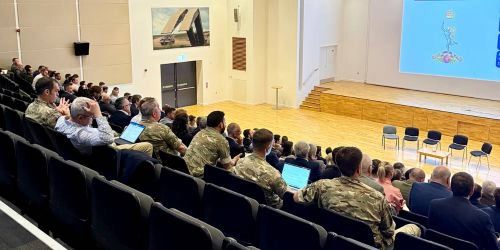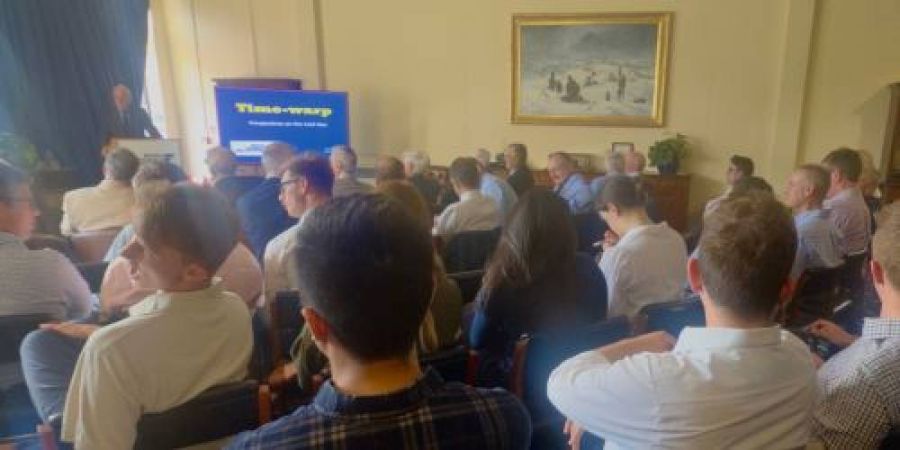
The Royal Signals Institution was privileged to welcome Major General (Retired) Bill Robins for a thought-provoking lecture exploring the geopolitical and technological dynamics of the Cold War, with particular focus on the British Army of the Rhine (BAOR) and the evolution of communications across the Corps.
General Bill’s distinguished career in military communications, electronic warfare, and crisis management spans both military and civilian domains. From leading tactical communications units within British Army formations to overseeing the construction of the UK government's protected crisis management bunker, his insights carry significant relevance for today’s strategic environment.
Understanding the Cold War standoff
Framing the Cold War as a 45-year global deadlock between the USA and USSR, General Bill traced its origins to the Yalta Conference of 1945. There, Stalin’s determination to secure Soviet borders through compliant buffer states paved the way for Soviet domination across Eastern Europe and set the conditions for confrontation with the West.
Germany - and Berlin in particular - became the epicentre of tension. From the 1948 Berlin Blockade to the construction of the Berlin Wall in 1961, the city symbolised the intensifying rivalry between two ideological opposites.
The brink of nuclear catastrophe
The lecture explored two near-catastrophic episodes in detail. The first, the 1962 Cuban Missile Crisis, remains a defining example of nuclear brinkmanship narrowly defused through diplomatic negotiation. The second, the lesser-known 1983 Able Archer incident, revealed how military exercises, miscalculation, and Soviet paranoia nearly triggered nuclear war.
General Bill credited the restraint of individuals like Soviet officer Stanislav Petrov, whose scepticism of an erroneous missile warning arguably prevented catastrophe. These moments underscored the fragility of peace and the dangerous logic of Mutual Assured Destruction (MAD), which crystallised following the Strategic Arms Limitation Talks of the 1970s.
The Corps at the forefront of communications innovation
Central to the Cold War, and to the lecture itself, was the critical role played by military communications - a domain where the Royal Corps of Signals was at the cutting edge.
General Bill detailed how the Corps transitioned from Combat Net Radio to pioneering area communications networks such as BRUIN and PTARMIGAN. He highlighted the Corps' collaboration with British innovators like Donald Davies of the National Physical Laboratory, whose work on packet switching contributed to the development of the internet. Despite operational challenges, these advances laid foundations for today’s digital communications and resilient command-and-control systems.
The lecture also exposed the outdated nature of the UK’s nuclear command structures during that era - including a reliance on ministerial cars fitted with radios, intended merely to direct the Prime Minister to a public telephone box (complete with strict instructions to carry loose change).
End of the Cold War - and lessons for today
The lecture concluded with reflections on the collapse of the Soviet Union, catalysed by internal dissent, economic failure, and the political courage of figures like Mikhail Gorbachev. The symbolism of the Berlin Wall’s fall in 1989 and the USSR’s formal dissolution in 1991 marked the Cold War’s end - sealed, as General Bill noted, with the irony of Gorbachev signing away the Soviet Union using a capitalist Montblanc pen.
Yet, the General warned, triumphalism and mismanagement of Russia’s post-Cold War transition created fertile ground for authoritarian resurgence. He cautioned that we may now face a new era of strategic competition - a different Cold War, but one demanding the same vigilance, humility, and investment in resilient communication systems.
Further Resources
The full slide deck from General Bill’s lecture is available [here]. RSI members are encouraged to suggest future lecture topics by contacting the RSI team via email - rsi-marketing-comms@royalsignals.org.