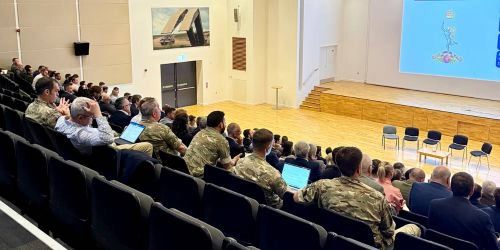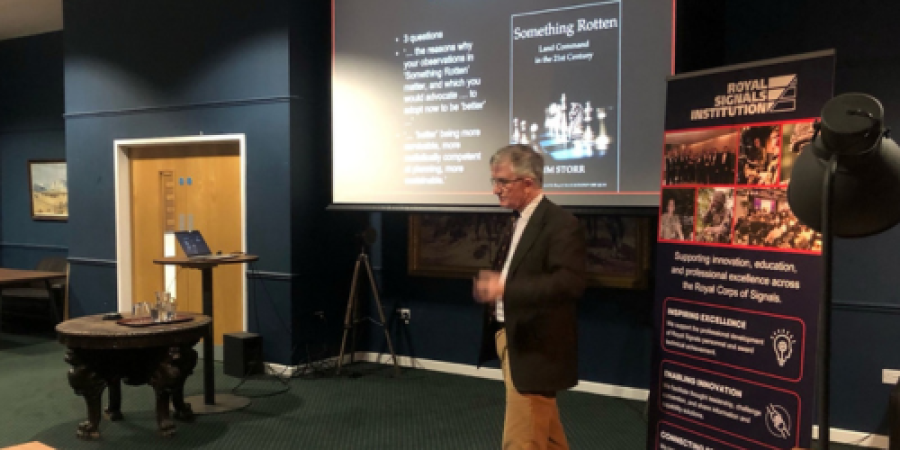
In a lecture by defence consultant and former British Army infantry officer Dr Jim Storr, explored the themes of his influential book Something Rotten: Land Command in the 21st Century.
Drawing on decades of operational experience, academic research and observation of headquarters across multiple armies, Dr Storr delivered a compelling critique of how modern land forces command and control their operations.
Are headquarters becoming too large?
Opening with a simple but revealing exercise, Dr Storr asked the audience three questions: are headquarters too large, are the orders they produce too complex, and do they take too long to produce them? The response was strikingly consistent. Over many years of asking these same questions to senior officers across the British Army and allied forces, Dr Storr found near-universal agreement that modern headquarters have become overly complex and inefficient.
His central argument was that command systems intended to support decision-making have gradually become obstacles to it. Headquarters have expanded in size, processes have multiplied, and planning procedures have grown increasingly bureaucratic. The result, he argued, is a system that often produces slow, cumbersome decision-making that struggles to keep pace with the tempo of modern operations.
The growth of process and planning complexity
A key theme of the lecture was the growth of formalised planning processes. Dr Storr illustrated this by comparing historical command doctrine with modern guidance. In earlier eras, operational planning methods were often described in just a few pages. Today, however, similar processes may extend to dozens of pages, prescribing detailed steps that staff officers must follow.
While these procedures aim to ensure thoroughness and coordination, they can also lead to inefficiency and excessive staff effort. Dr Storr recounted an exercise where a planning task that could once be taught and completed in under an hour took a modern headquarters many hours to complete when every procedural step was followed.
Another challenge arises from the way decisions are often made collectively within large headquarters teams. Drawing on insights from organisational psychology, Dr Storr noted that committees tend to settle on the option everyone can agree on rather than the best possible course of action. This dynamic can lead to cautious, lowest-common-denominator plans rather than bold and effective operational thinking.
Technology: enabler or constraint?
Technology also featured prominently in the discussion. Modern command systems provide commanders with unprecedented volumes of information and powerful digital tools. However, Dr Storr warned that digitalisation can sometimes reinforce bureaucratic behaviour. In some cases, staff processes become driven by the requirements of software systems rather than the needs of commanders, effectively making staff officers “slaves to the machine.”
To illustrate how simpler approaches can still succeed, Dr Storr highlighted historical examples of effective command, when relatively small planning teams generated large numbers of contingency plans, many of which were never used in practice. At the same time, smaller and more agile headquarters were able to operate effectively with limited staff structures and simpler planning processes.
Returning to the fundamentals of command
Dr Storr argued that the solution is not necessarily more technology or additional staff, but a renewed focus on the fundamentals of command. Smaller headquarters, clearer intent, and greater trust in skilled individuals could restore agility to land command. In particular, he emphasised the importance of developing highly capable planners who can rapidly translate a commander’s intent into concise and effective orders.
The lecture also touched on professional culture within the military. Dr Storr suggested that modern training environments sometimes discourage risk-taking and experimentation. Historically, commanders were expected to test ideas, make mistakes and learn from them during exercises. Re-introducing this culture of experimentation, he argued, would help rebuild the confidence and judgement required for effective command in complex operations.
Continuing the conversation
The evening concluded with a lively discussion and questions from the audience, reflecting the enduring importance of command and control as a core military capability. For the Royal Signals community in particular, the lecture highlighted the critical relationship between communications systems, information management and effective decision-making.
Dr Storr’s presentation served as a timely reminder that while technology and organisational structures continue to evolve, the essence of command remains unchanged: enabling commanders to make clear, timely decisions and communicate intent effectively across the force.