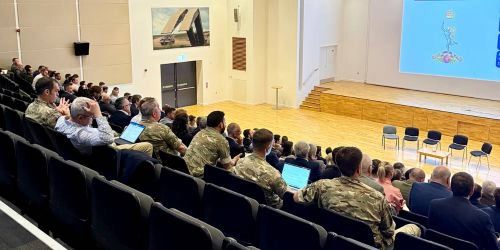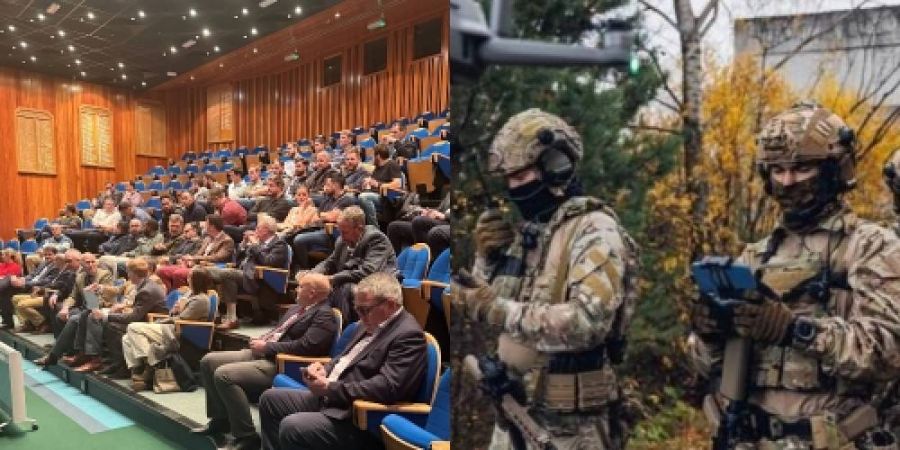
The Royal Signals Institution recently hosted a highly engaging professional lecture on Electromagnetic Spectrum Operations (EMSO) and the increasingly critical role of the high–low mix in modern warfare. Delivered by Wing Commander (Retd) John McFadden - a highly experienced practitioner in electromagnetic warfare and spectrum operations - the lecture explored how control of the electromagnetic spectrum has become decisive in contemporary and future conflicts.
Drawing on recent operational lessons, particularly from Ukraine, John framed the electromagnetic spectrum as key terrain: contested, congested and constantly evolving. In such an environment, success no longer depends solely on a small number of exquisite, high-end capabilities. Instead, advantage is increasingly derived from the intelligent integration of high-end effects with scalable, lower-cost and rapidly deployable systems - the essence of the high–low mix.
EMSO as a Warfighting Function
At the heart of the lecture was the argument that EMSO must be understood and employed as a core warfighting function, not merely a supporting activity. John emphasised that electromagnetic superiority - the degree of control that permits reliable operations without prohibitive interference - is often the enabling condition for success across all other domains, including air, land, maritime, cyber and space.
Historically, spectrum activity has focused heavily on deconfliction and management. However, John highlighted that this mindset is no longer sufficient. Modern operations require forces to sense, understand, decide and act within the electromagnetic spectrum - often at speed, and often while under active adversary pressure. This demands a shift from passive spectrum awareness to active electromagnetic manoeuvre.
Lessons from Recent Conflicts
The lecture placed particular emphasis on recent conflicts, where the pace of innovation and counter-innovation has been measured in weeks rather than years. In these environments, the traditional acquisition cycle struggles to keep up with operational reality. John outlined how adversaries are exploiting the electromagnetic spectrum aggressively, forcing friendly forces to adapt continuously simply to survive.
A key lesson highlighted was the danger of assuming permissive training environments will prepare forces for contested operations. The electromagnetic battlespace today is densely populated with civilian and military emitters, making detection, concealment and manoeuvre increasingly complex. The ability to “drive wedges” into an adversary’s spectrum environment - achieving localised, temporary advantage before withdrawing - was identified as a critical skill.
Training, Simulation and Culture
A recurring theme during the discussion was the challenge of training for EMSO in peacetime. Live experimentation in the UK is constrained by regulatory, legal and policy frameworks, while high-fidelity simulation can be expensive and difficult to scale. John argued, however, that progress does not require perfect solutions. Lower-cost software-based tools and synthetic environments can still build familiarity and intuition, helping personnel understand how the spectrum behaves and how their own actions create signatures.
Importantly, John cautioned against attempting to “sprint before walking”. Building electromagnetic competence requires progressive training — starting with basic awareness and discipline, before advancing to complex manoeuvre and integration. Cultural change is as important as technology: operators must understand that every transmission has consequences.
From Awareness to Action
The lecture concluded by reinforcing the need for integration - between people, processes and technology. EMSO cannot succeed in isolation; it must be embedded within command and control structures, intelligence processes and operational planning. Open, modular architectures and rapid prototyping were highlighted as enablers, allowing forces to adapt quickly and exploit both high-end and mass capabilities.
In closing, John left the audience with a clear message: the electromagnetic spectrum is no longer a background consideration. It is an arena of active competition, where advantage is temporary and must be continually earned. Mastery of the high–low mix — combining exquisite capability with affordable mass and speed - will be essential if Defence is to maintain freedom of action in future conflicts.