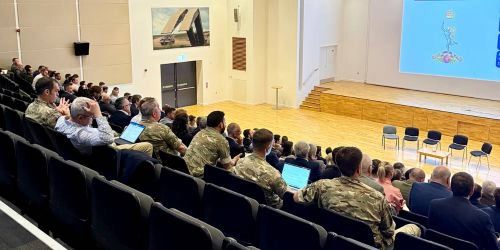
In a recent lecture hosted by the Royal Signals Institution, Lieutenant Colonel Tom Skinner, Commanding Officer of 2 Signal Regiment delivered an insightful session on the realities of modern divisional command and control (C2) in high-readiness operations.
Held at the Officers’ Mess, MOD Stafford, and broadcast online, the talk attracted broad engagement from across the Corps and Defence industry, demonstrating the growing interest in next-generation communications and the critical lessons emerging from NATO deployments.
Rethinking Command and Control in a NATO Context
The Allied Reaction Force represents one of NATO’s most demanding readiness commitments, and 2 Signal Regiment played a pivotal role in enabling the C2 structure for 1 (UK) Division’s deployment.
At the heart of Lt Col Skinner’s talk was a bold reimagining of divisional C2 - moving away from static, heavily protected command posts toward a dispersed, flexible, and survivable network architecture. The regiment has supported a distributed and dispersed C2 model across several HQs and functions concurrently.
Agility and Survivability in the Field
To meet the ARF’s unique requirements, 2 Signal Regiment adopted a range of innovative approaches:
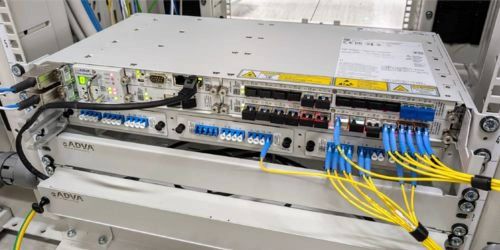
- Low maintenance equipment and commercial-off-the-shelf (COTS) technologies enabled rapid setup and teardown of Command Posts (CPs).
- Remotely Enabled Nodes (RENs) and use of pre-existing infrastructure allowed CPs to relocate in under 90 minutes - compared to 12 hours under traditional models.
- Network distribution was extended beyond brigade HQs to individual battle groups and embedded SMEs.
- A Network Management Control Centre (NMCC) was established in York to monitor and manage network operations remotely. This centralised hub drastically improved fault resolution, reducing the need for external support by over 90%. Soldiers were trained in-house to develop expertise and ownership, enabling what was referred to as “level 2.5 engineering” support.
- Dispersal of CP functions across multiple locations ensured redundancy and resilience without overstretching enablers.
This approach directly challenged assumptions around survivability, creating a structure that emphasised mobility, redundancy, and command decentralisation over protection and standardisation.
Train as You Fight: From Doctrine to Reality
One of the lecture’s most compelling insights was how 2 Signal Regiment validated its innovations in real-world conditions. Exercises used deployable CIS equipment exactly as intended for live operations, stressing systems through realistic use of the PACE (Primary, Alternate, Contingency, Emergency) communications model.
By aligning validation activity with operational requirements, the Regiment was able to fine-tune its approach and drive a culture of tactical realism.
Lt Col Skinner also emphasised the importance of doctrinal flexibility. The ARF deployment required a departure from traditional models yet retained tight alignment with UK doctrine, demonstrating that adaptation need not mean divergence.
Strategic Significance
The lessons shared from this deployment extend far beyond one operation or formation. They reflect a broader need within NATO and UK Defence to think differently about how we command, control, and communicate in dynamic environments.
For those working at the interface of CIS, C2 doctrine, and force readiness, this lecture offered valuable evidence of what can be achieved when agility, technical acumen, and bold thinking come together.
As Defence continues to embrace digitisation and dispersal, the ARF deployment may prove a blueprint for the future.
Further Resources
The full slide deck from Lt Col Skinner’s lecture is available [here]. RSI members are encouraged to suggest future lecture topics by contacting rsi-marketing-comms@royalsignals.org.