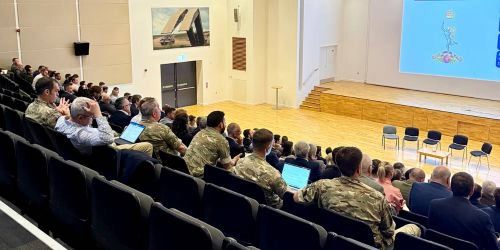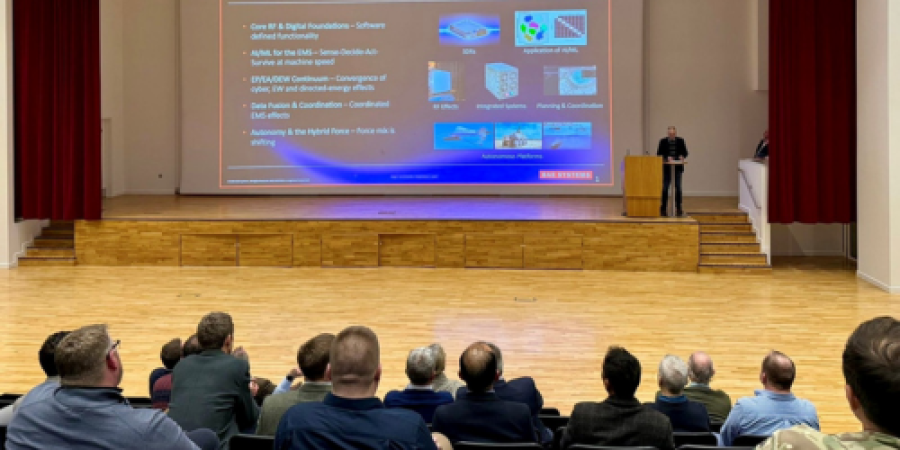
Last week, we hosted Mark Todd, Innovation and Technology Director at BAE Systems, and Tim Barraclough, Head of Capability for Sense and Effect. Together, they explored how adaptive warfare and modular CEMA (Cyber and Electromagnetic Activities) are reshaping the modern battlespace.
The session opened by framing the electromagnetic spectrum (EMS) as a critical domain of warfare - one that is increasingly contested, congested, and continuously evolving. Drawing on lessons from recent conflicts, the speakers highlighted how adversaries are rapidly exploiting the spectrum to detect, disrupt and deceive, often using commercially available technologies and adapting faster than traditional defence procurement cycles can respond.
Operational reality: A fight for speed and advantage
A key theme throughout the lecture was the pace of change. Modern conflict is characterised by continuous adaptation, where advantage is fleeting and must be constantly regained. The ability to sense, understand, and act within the EMS at speed is now fundamental to operational success.
Recent operations have demonstrated that forces must be able to operate effectively in degraded and denied environments. This includes maintaining communications, navigation, and situational awareness despite persistent interference. As a result, resilience is no longer a desirable feature - it is an operational necessity.
Open architectures: Enabling agility and integration
Central to achieving this resilience is the adoption of open, modular architectures. The speakers emphasised that traditional, platform-specific systems are no longer sufficient in an environment where threats evolve rapidly.
A Modular Open Systems Approach (MOSA) allows capabilities to be developed, upgraded, and integrated far more quickly. By separating hardware and software, and adopting common standards, defence can:
- Integrate new technologies without redesigning entire systems
- Enable interoperability across platforms and coalition partners
- Reduce costs and accelerate capability delivery
This approach also opens the door to greater collaboration with industry, allowing innovation from SMEs and non-traditional suppliers to be more easily integrated into operational systems.
Technology: Accelerating the sense–decide–act cycle
Advances in technology are underpinning this transformation. The lecture explored how developments in software-defined radios, artificial intelligence, machine learning, and data fusion are enabling faster and more informed decision-making.
In a modular CEMA framework, these technologies support the full operational cycle-sense, decide, act, and survive. Systems must be able to detect signals, interpret complex data, make decisions at machine speed, and adapt in real time to counter emerging threats.
However, the speakers were clear that technology alone is not the solution. The effective integration of these capabilities depends on people, processes, and training, as well as the ability to trust and share data across organisational boundaries.
Modular CEMA in practice
The practical application of modular CEMA was illustrated through real-world examples. A layered and flexible approach allows forces to deploy a mix of capabilities tailored to the mission—combining high-end systems with lower-cost, scalable solutions.
This “high–low mix” enhances both capability and resilience. High-end systems provide precision and advanced effects, while lower-cost solutions increase mass, persistence, and adaptability. Together, they create a more robust and survivable force.
A coalition-driven imperative
Interoperability emerged as a critical requirement for future operations. The speakers stressed that coalition working must be considered from the outset, with systems designed to operate seamlessly with allies.
This requires not only technical alignment, but also shared standards, governance, and trust frameworks to enable effective data sharing and coordinated action across multinational forces.
The lecture concluded with a clear and compelling message: adaptive warfare is not a future concept - it is a present-day reality. To remain competitive, defence must embrace modularity, open architectures, and continuous innovation.
In a battlespace where threats evolve in real time, success will depend on the ability to adapt just as quickly. Modular CEMA offers a pathway to achieving this—delivering the speed, agility, and versatility required to operate and prevail in the electromagnetic spectrum.