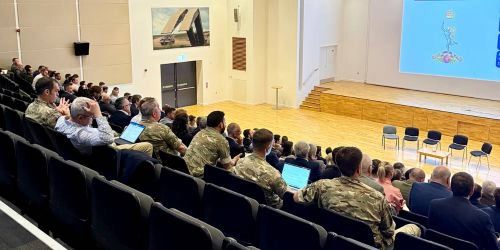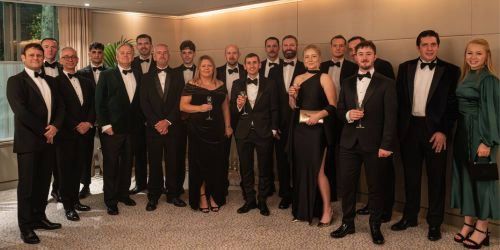
Nearly 80 corporate members of the Royal Signals Institution attended an excellent capability demonstration hosted by 1 (UK) Signal Brigade at Imjin Barracks this week.
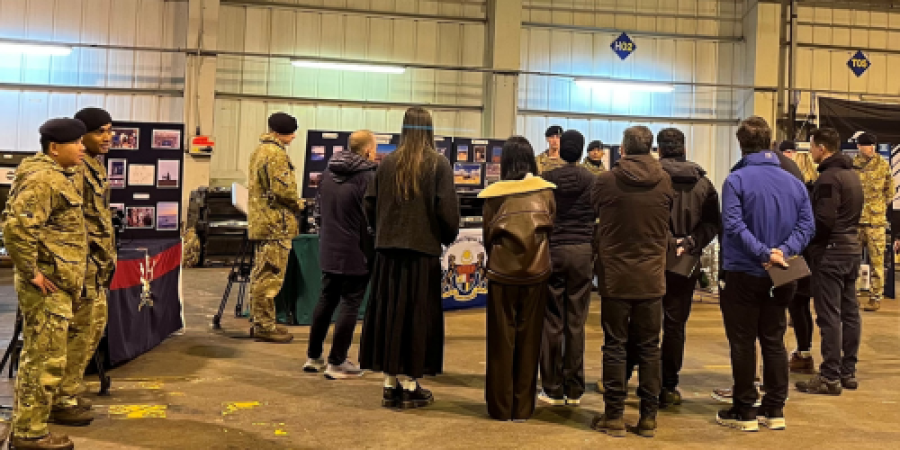
Guests received an engaging opening brief from Brigadier Brian Jeffery, Commander 1 (UK) Signal Brigade, before moving on to a series of stands illustrating how the Brigade delivers information manoeuvre across its Advance, React, and Respond framework. Corporate members heard how this is done globally and in direct support of NATO’s Allied Rapid Reaction Corps (ARRC).
ADVANCE – Projecting capability forward. Units delivering strategic‑level communications, long‑range connectivity, and specialist information capabilities, including: 30 Signal Regiment – providing globally deployable communications.
REACT – Supporting rapid deployment and early entry forces. Units enabling tactical communications, early‑entry support, and resilient CIS in fast‑moving environments:
- 16 Signal Regiment – air‑manoeuvre and rapid‑response tactical communications.
- 10 Signal Regiment – UK Ops, global infrastructure readiness, and specialist CIS support.
RESPOND – Sustaining operations and enabling multinational integration. Units underpinning enduring operations, NATO interoperability, and large‑scale CIS nodes:
- Gurkha ARRC Support Battalion – providing power, infrastructure resilience, and logistic sustainment.
- 39 Signal Regiment – HF, electromagnetic spectrum and long‑range communications development.
- 280 Signal Squadron (NATO) – delivering assured CIS to NATO headquarters.
- 22 Signal Regiment – large‑scale formation communications and multinational integration.
- 32 Signal Regiment – reserve enabling support to UK and overseas operations.
The event gave attendees a clear, first‑hand appreciation of how each unit contributes to the Brigade’s operational output - from rapid‑response tactical communications to the delivery of strategic, coalition‑ready information capabilities.
Richard Castle, Product & Strategy Director, Thales thanked the team for the efforts in presenting the capability, pulling the curtain back and inviting them to have some direct access to teams doing amazing things for Allied Rapid Reaction Corps: "I took some great insights away and was impressed to see how creative the teams had been working within their budget limits to innovate and think differently."
Noddy Baugh, Digital Intelligence, BAE Systems, added: "Was pleased to see many young people attending the RSI backed element from Industry who can only learn and as always, it’s good to be with people, the uniformed Corps and [understand] how they innovate."
The Royal Signals Institution extends its sincere thanks to Brigadier Brian Jeffery and the entire Brigade for their exceptional hospitality, professionalism, and the effort invested in delivering such an informative and impactful afternoon.