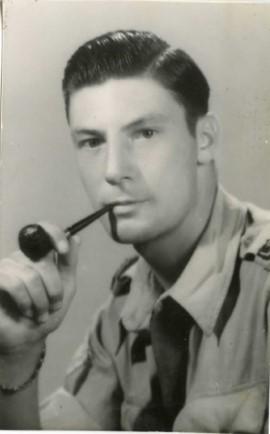
Article by Museum volunteer, Mr Ron Abbott
Roy Frederick Arthur Plowright was born in Marylebone, London on 22nd April 1924. When the Second World War broke out he was a clerk living in Acton; conscription applied at the age of 18, so he was unable to enlist until spring 1942. He was drafted into the Royal Corps of Signals on 3rd June 1942, moving to Catterick Training Battalion to complete military and trade training as an Operator Wireless and Line (OWL).
In December 1942, having passed his trade training exam, Roy was posted to a holding company of 47 Division Signals Regiment, then based in Thirsk. His posting orders show that he joined 80 Div Signals. It was here that his service with the Long Range Desert Group (LRDG) began in November 1943. The North Africa campaign was winding down in early summer 1943, so the LRDG undertook re-training in Egypt and Lebanon to prepare for reconnaissance tasks in Southern Europe. The LRDG operations in this new theatre started in September 1943 - unfortunately their patrols sustained considerable casualties at this time, including several Royal Signals soldiers. These patrols included shipping watch wireless reporting stations, who frequently came under German attack.
Plowright’s service record shows periods of active service in Italy of 1 year 8 months, Yugoslavia-Albania-Greece 4 months and France for 1 month. He survived this period without injury and was promoted to the rank of Corporal. The LRDG disbanded on 21 June 1945 and Roy’s posting from this unit was 18 July 1945, he returned to 80 Division Signals and then 48 Signals. It is significant that his following posting was to 13 Corps Signals Regiment in January 1946, which subsequently became 13 (EW) Signal Regiment based in Germany. He was promoted to Sergeant and life became more relaxed after the Second Word War ended.
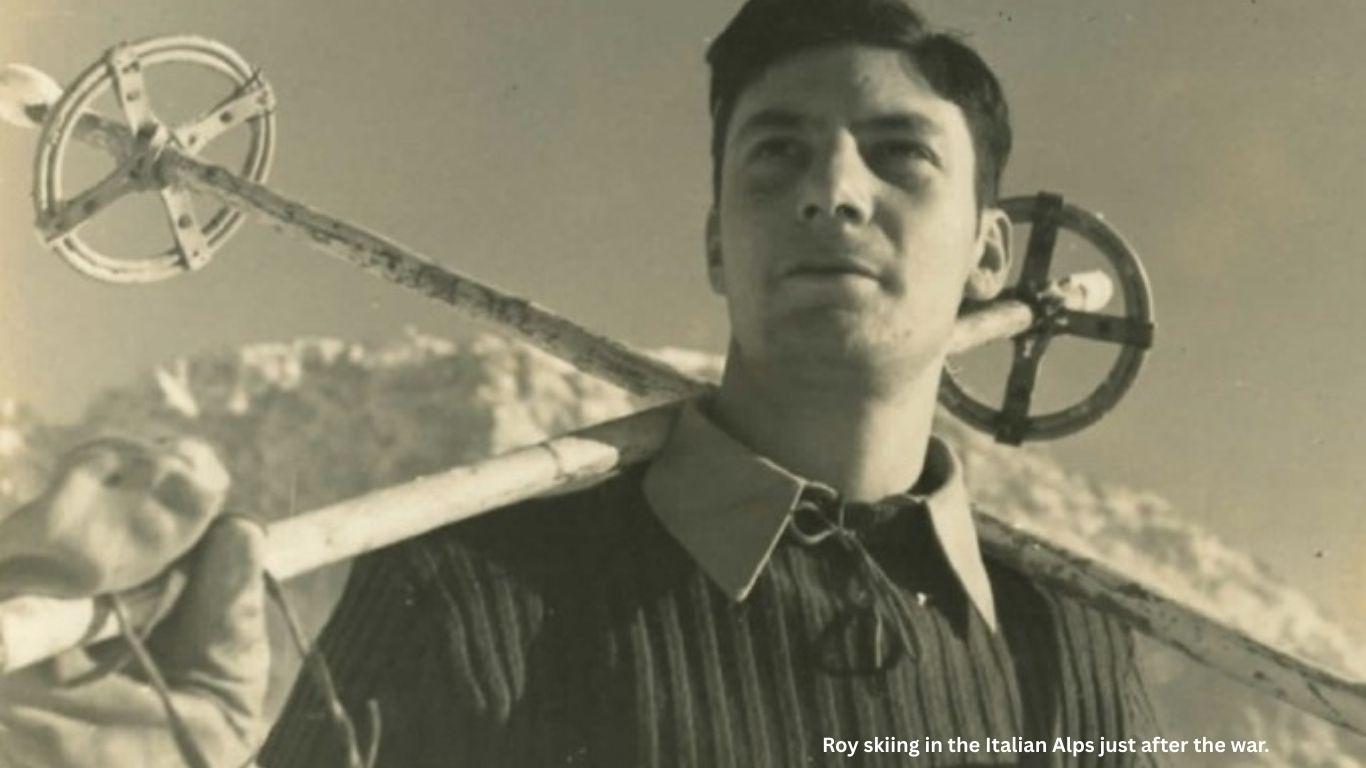
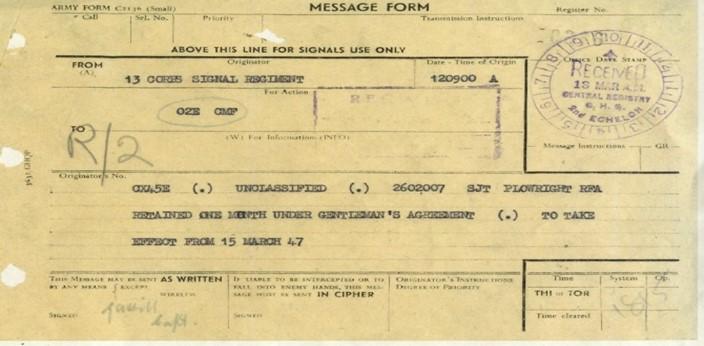
We know that Roy was based somewhere near Monfalcone, Trieste, Italy in April 1946, as there is an injury report confirming that he seriously injured his leg whilst playing an inter section soccer match on the Monfalcone football ground. He left 13 Signals in April 1947, but there was an interesting document held by Royal Signals Records (below). It was ‘A gentlemen’s’ agreement’ to extend his posting by one month. This might not work today in Royal Signals!
Roy was finally SOS of the Royal Signals Reserve as he was moving his residence permanently overseas, aged 28. His address was shown as being care of the Shell Oil Company based in Singapore. We might consider that the 1st August 1952 was the finish of Roy’s service with Royal Signals, but as we shall see this was not quite the case. He moved from a home in Bath to Shillingstone near Blandford, where he became a neighbour of Stan Vannan (Lt Col Tfc, Rtd, 1963-1998).
Stan relates:
"Roy moved from Bath to Shillingstone around 1992 and sadly, lost his first wife through illness shortly thereafter. He remarried to Brenda, the widow of a colleague he had accompanied on a number of battlefield tours. The wedding took place in Gibraltar and they had a very happy and sociable marriage.
I grew closer to Roy as he grew older and particularly after Brenda passed away. We talked a lot and from these encounters, I learned of his service with R Signals, LRDG and SAS. In common with others of his generation, he strictly observed the tenets of the Official Secrets Act, and to the point it was not for many years after they were married that his first wife learned of his wartime service and conversely, he became aware that she had been employed in Y Service (Wireless Communications). In line with this guarded approach, he had a charmingly disarming way of glossing over detail and avoiding close questioning about his wartime activities. I am aware, however, that he attended at least one formal event at Hereford and attended a number of gatherings at the Special Forces Club in Kensington, which would seem to attest to his service with Special Forces.
I was also aware that at some later stage in his career, he was resident in Singapore, working in shipping, import and export. But although he never specifically said so, I deduced he had also been active to some extent on behalf of a Government agency or the Foreign and Commonwealth Office. His Singapore home was used on a number of occasions for official business and I was aware that he was widely travelled throughout the Far East - Hong Kong, Singapore, Malaysia, Brunei, Sabah and Sarawak and was very familiar with much more than the usual military landmarks.
He certainly had his finger on the political pulse of the area. He had the most amazing recall for detail. On one occasion, I related a story about a foul and isolated logger's bar I had once visited on the banks of the river on the outskirts of Limbang. Not only had he been there, but he also knew the barman and was able to accurately describe the memorably foul pattern on the worn carpet in the bar.”
It was during this period that Roy, as related by Jim Ross (Lt Col Tfc, Rtd, 1961 -1997), became a guide at the Royal Signals Museum. Jim takes up the tale:
" Ihad on a number of occasions the pleasure to share weekend duty in the Royal Signals Museum shop with Roy. On our first encounter I noticed that he was wearing the Special Air Service (SAS) small insignia badge on his lapel and obviously I asked him about it. He readily informed me that he had been a member the Long Range Desert Group (LRDG) during World War II. I knew the LRDG to be the precursor to the forming of the SAS.
Roy never freely talked about his time served in the war and therefore I never attempted to draw him on the subject. I can say that he was always properly dressed in a semi formal manner and had impeccable manners. Roy was a gentleman in every sense of the word and always socially very good company.”
Whilst serving as a guide at the museum Roy decided to request the documents relating to his military service. We are therefore able today to put together the details contained in this memoir. His collection included the photographs and a letter written to Roy (aged 91) by the French Ambassador in London dated 21 September 2015.
"I have the pleasure of informing you that the President of the Republic has appointed you to the rank of Chevalier in the Ordre national de la Legion d’honneur. I offer you my warmest congratulations on this high honour in recognition of your steadfast involvement in the Liberation of France during the Second World War. As we contemplate this Europe of peace we must never forget heroes like you who came from Britian and the Commonwealth to begin the liberation of Europe by liberating France. We owe our freedom and security to your dedication because you were ready to risk your life. I am happy to enclose your insignia of Chevalier de la Legion d’honneur and once again extend my heartfelt congratulations.”
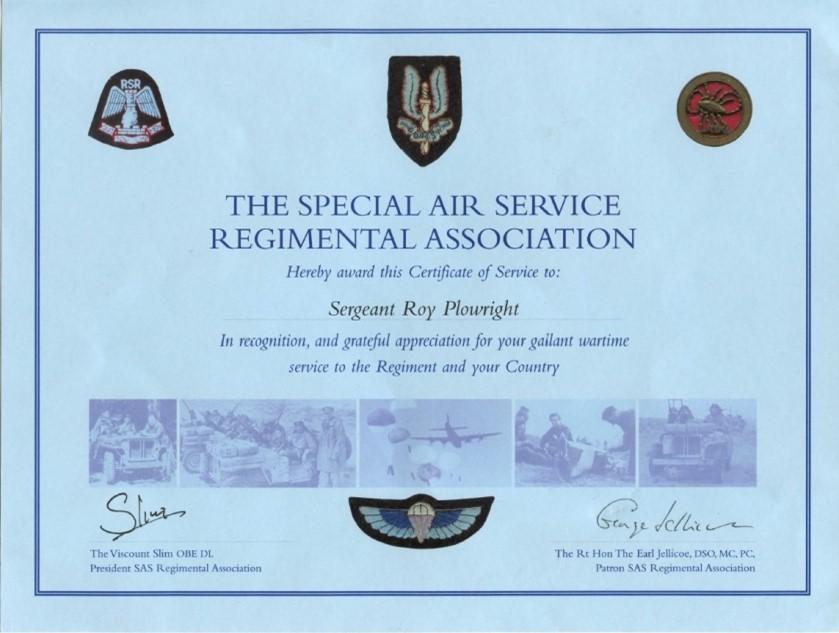
Roy died in February 2017 aged 93. Jim Ross’s final comments are so appropriate for this extraordinary gentleman who served his country and Royal Signals with such great distinction:
"On his passing I attended Roy’s funeral. Just as we were about to enter the crematorium Chapel I noticed a minibus draw up and about 10 to 12 personnel approached the Chapel. I asked them if they knew Roy and they all answered “No” but they were all SAS veterans who had heard about his passing and had come to pay their respects. A very touching tribute to a modest and truly remarkable man.”