Written by Ryan Ellis
Head of Storytelling, Royal Signals Museum
Reproduced from The Wire
In April 1944, Japan commenced its largest offensive of the Second World War. Operation Ichigo became a swift and decisive sweep across central and South-East China. Authorities in the Republic of China had dismissed early intelligence reports about the possibility of a fresh attack as mere propaganda. Consequently, they were somewhat blindsided by the 500,000 Japanese troops who rapidly took the provinces of Henan, Hunan and Guangxi with the aim to open a land route to French Indo-China. When the offensive was halted in December, China had effectively been cut in two.
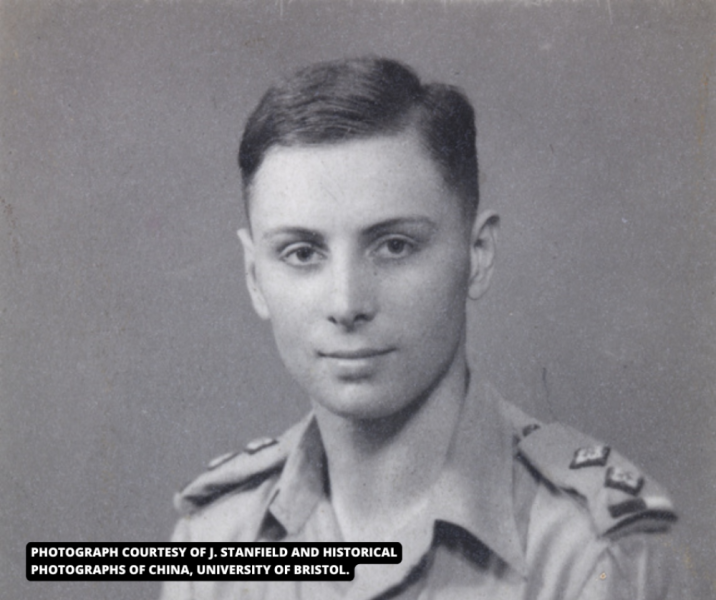
The following summer, a young Royal Signals officer travelled with a team headed by the Chinese Director of Military Intelligence, Major-General Ho Kan Tzen, to set up 2 wireless stations, nicknamed Sparrow and Crow, along the Yellow River for the Chinese forces.
Captain John Stanfield was employed by Force 136, the far eastern branch of the British intelligence organisation known as the Special Operations Executive (SOE). Others in the jeep touring team were a bodyguard, Ho’s secretary, a mechanic, 2 wireless operators and a servant. With Japanese forces occupying the opposite side of the river bend, and gun fire peppering the night sky, the mission was a hazardous undertaking. In fact, a reward was offered by the Japanese for information that would lead to the arrest of an allied officer.
The Chinese operators were trained to use the British Type 3 Mk. II, more commonly known as the B2 suitcase radio. Designed in 1942 by Captain John Brown at SOE Station IX, these sets were manufactured by the Radio Communication Department at Stonebridge Park. Each transmitter used 2 valves: a VT52 as a crystal oscillator and a 6L6 as a power amplifier. Whilst substantial in weight, the B2 was considered relatively small for its day and produced an HF output power of 20 watts.
Though the B2 could run off a 6-volt battery, the power packs quickly ran flat. As a work around, Stanfield trialled a charging competition amongst his Chinese operators. “They were terribly keen”, he recalled in an oral history interview with the Royal Signals Museum. “We had this hand-worked crank. They each worked very hard for 5 to 10 minutes until they were exhausted and the next person took over.” This method only produced about 0.1 amps, unviable to consistently meet the wireless schedule.
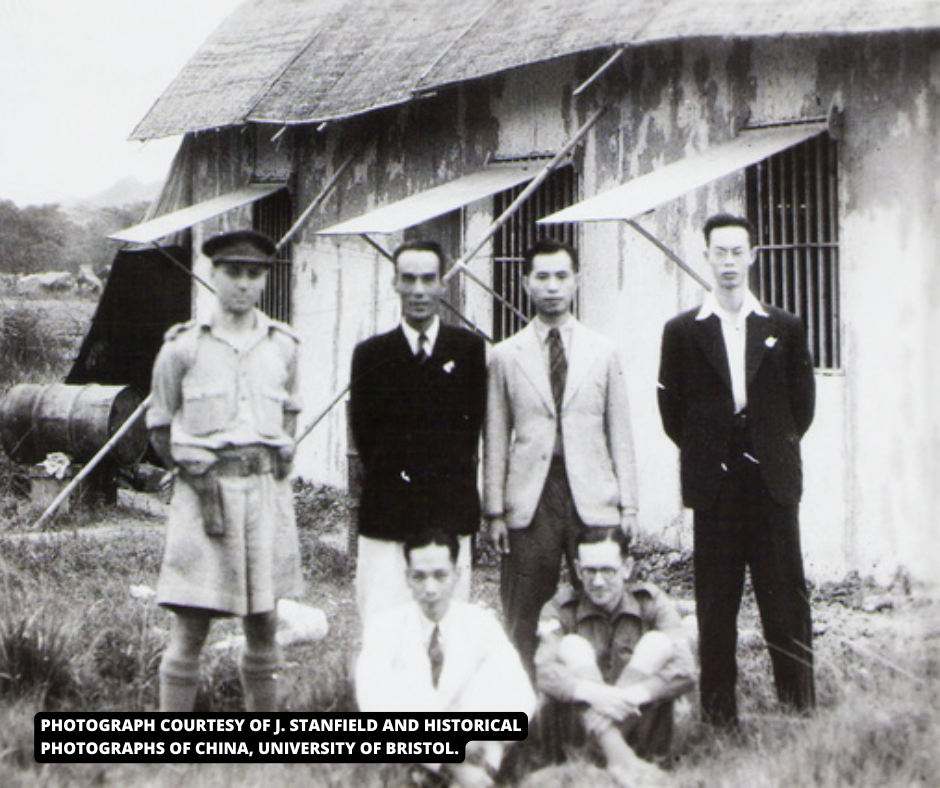
In this dry environment, Stanfield devised an alternative solution: a small steam generator which had travelled with them from the War Zone Commander’s Headquarters in Sian/Xi’ian and was fuelled by the residue of the local cotton crop.
He sought to develop operative field reporting, too. In a contemporary account, he wrote: “If the agents had to walk to deliver information, it would be totally out of date. I got hold of two walkie talkies, just produced, so that the agents could speak across the river.”
After establishing the Sparrow and Crow stations, Stanfield accompanied Major-General Ho back to Sian/Xi’ian. It was here, on 11th August 1945, that Stanfield received the news that the United States had detonated two atomic bombs over the Japanese cities of Hiroshima and Nagasaki. The axis power had capitulated, as a result.
Promoted to Acting Major, John Stanfield later witnessed the surrender of the Japanese on behalf of the British Army. The ceremony took place on the Dragon Pavement in front of the Grand Coronation Palace in Peking/Beijing. Recalling the 10th October 1945, Stanfield said: “There was a triumphal shout as seven years of subjugation was ended by the humbling of these officers about to surrender their swords on the spot where defeated enemies of China have surrendered their symbols of war for the last five hundred years.”
.png)
According to official accounts, the Sino-Japanese War killed between 14 and 20 million Chinese people, although revised studies by historians conclude that the true number may be far higher. Interested to learn more? John’s story and the context for the Japanese surrender features in a new book entitled One October Day in Peking: The Japanese Surrender by David Johnson.
LISTEN TO JOHN TELL THIS STORY IN HIS OWN WORDS: https://guides.bloombergconnects.org/en-US/guide/royalSignals/item/900f657a-f621-4bed-97b4-b23d1e7426cf